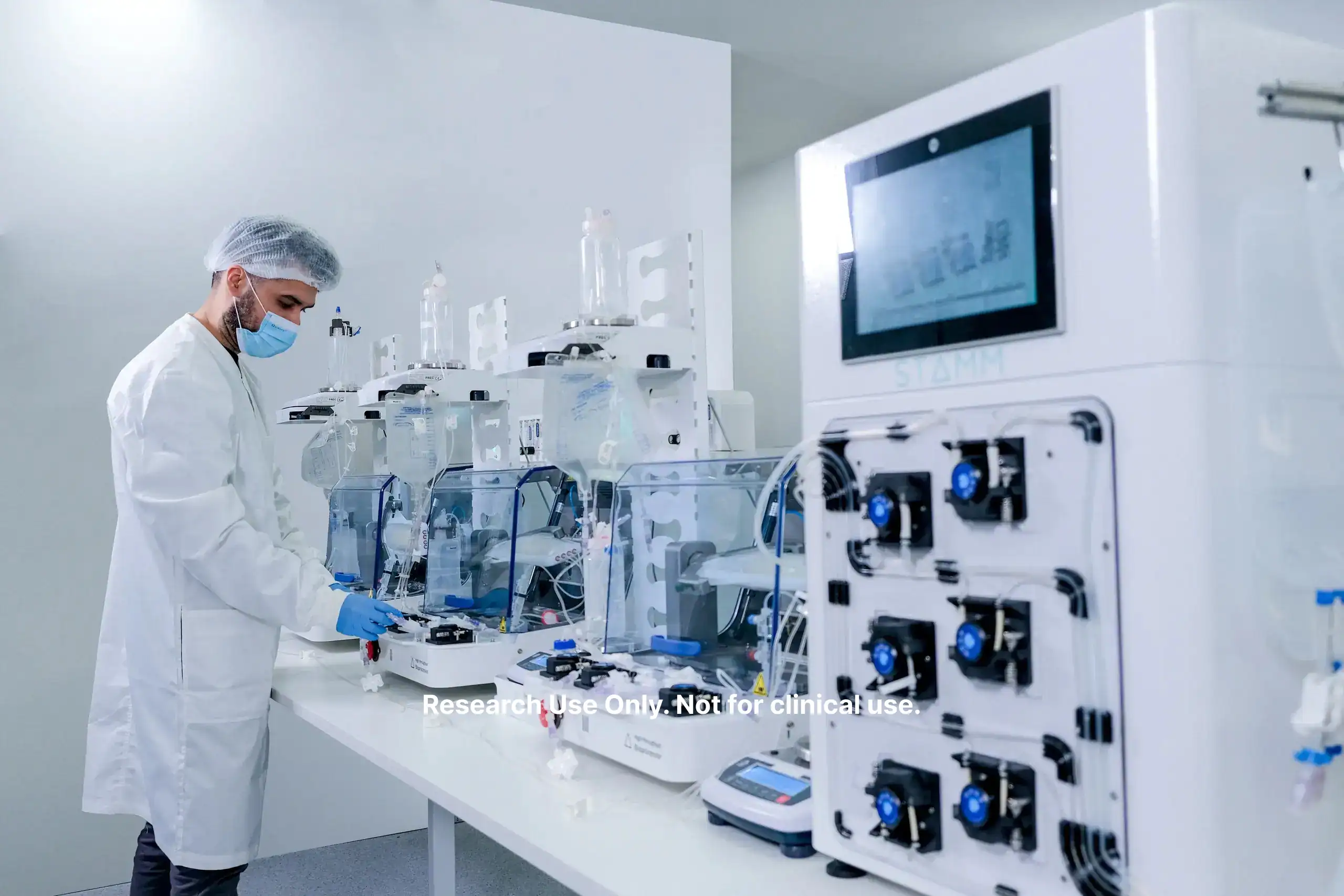
If the best athletes in the world turn to their own cells to heal an injury, how do we open that door for everyone else? With that question, Juan Martín Cabaleiro, our CTO, opened his talk at Crossing Over in Buenos Aires on October 21. And he didn’t come alone: the Stämm team set up a booth with the High-Throughput Bioprocessor (HTB) running live demos, and several Stämmers stayed to talk with everyone who stopped by.
Three ideas from the talk
- What matters is how we ask cells to do their work. Stirred-tank bioreactors rely on bubbles and impellers, which create turbulence and foam and are patched with antifoam. Adherent cell cultures, meanwhile, still depend on flasks and cell stacks, with many manual steps.
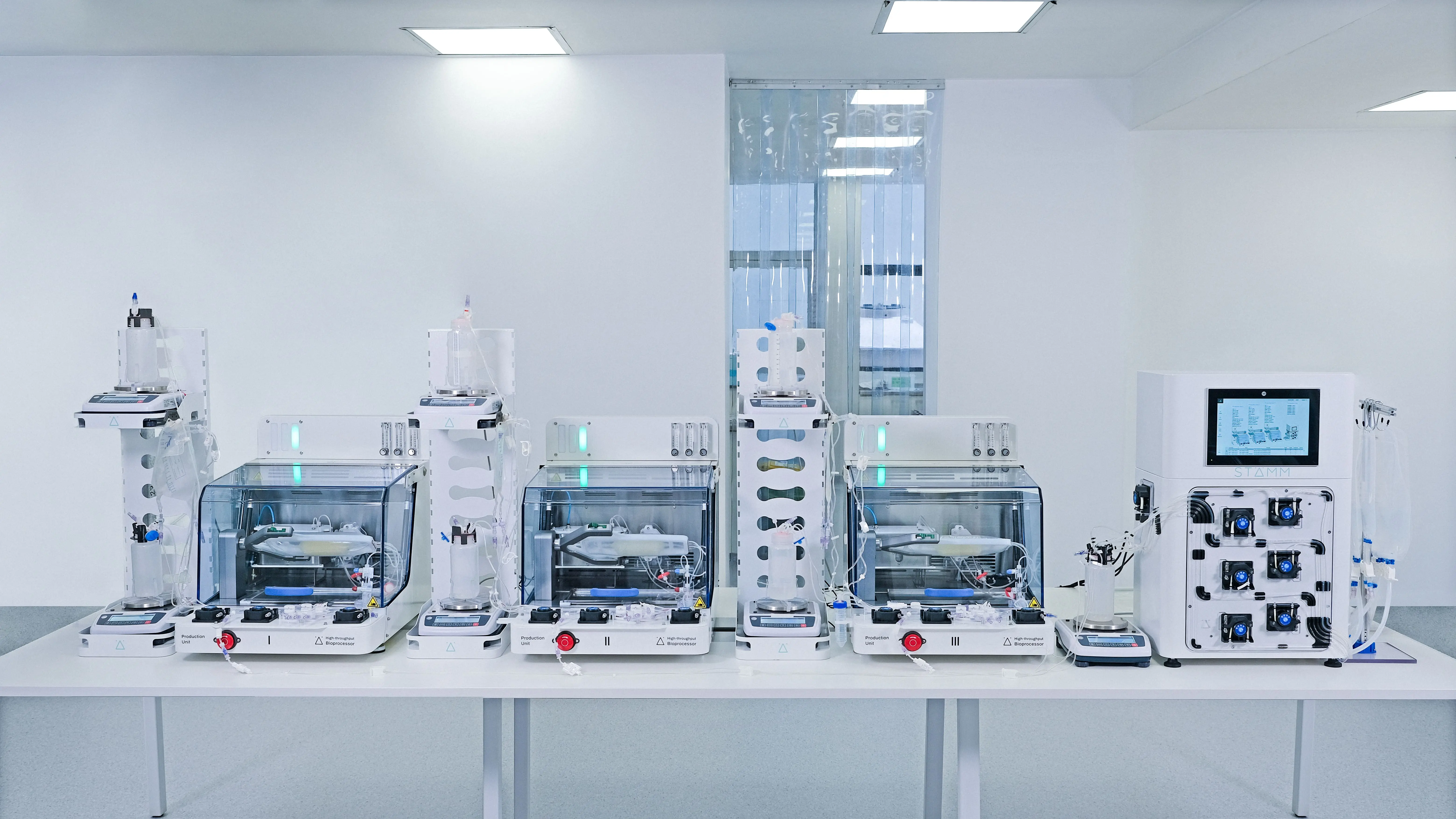
- Nature grows cells differently. Its flows are laminar, gas moves passively, and vascular systems take the place of paddles. That is where the HTB design comes from, modeled on the human body: a control unit with sensors (the nervous system), peristaltic pumps (the heart), microfluidic tubing (the blood vessels), and a formulation unit alongside the bioreactor (the digestive system and lungs).
- The Bubble-Free Bioreactor (BFB) adapts the system to the cell. It is a 3D-printed, gyroid-shaped cartridge made of a biocompatible material that lets gases through but not liquids. There are no bubbles, impellers, or antifoam: oxygen crosses the wall and the medium flows in continuous perfusion. It works for suspension and adherent cells, with different cartridges. The 60 mL BFB offers a capacity equivalent to more than seven T175 flasks, and a single control unit runs up to three production units in parallel.
What we showed at the booth
Martina Porto, Agustina Thibaud, Marco Sottile, Imano Agüero, and Ludmila Budzynski ran the system live: sampling and inoculation step by step from the control screen, with a color indicator showing how the inoculum homogenizes.
About Stämm
Stämm is a biomanufacturing company with teams in San Francisco, Buenos Aires, and Monthey (Switzerland). It started with two cousins who wanted to make liquid yeast for beer, went through Singularity University, GridX, and IndieBio, and today builds automated, nature-inspired platforms to decentralize biological production.
Available now for research use
The HTB and the BFB are on sale for research use only (RUO): they are not for diagnostic or clinical use. We designed them with GMP in mind, and that path is on our roadmap. We are looking for partners to build this together.
Want to see it running in your lab? Watch the full demo: video. get in touch: info@stamm.bio or buy now.
Thank you to the Crossing Over organizers for the space, and to everyone who came by with questions.